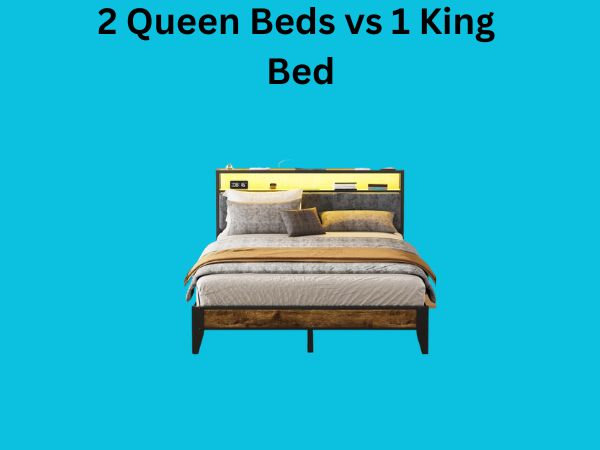
2 Queen Beds vs 1 King Bed: Which Option Is Right for Your Bedroom?
When you’re shopping for a bed or redesigning your bedroom, one of the biggest decisions you’ll face is whether to go with two queen beds or a single king bed. It sounds simple enough on the surface, but there’s actually quite a bit to consider before making your final choice. The decision affects everything from your sleep quality and comfort to the overall layout of your room and your lifestyle needs.
I’ve watched many people struggle with this choice, and honestly, there’s no one-size-fits-all answer. What works perfectly for a couple with a teenage guest room in mind might be completely wrong for newlyweds prioritizing intimacy. That’s why I’m breaking down this comparison in detail so you can make an informed decision that truly fits your situation.
Understanding the Basic Dimensions
Before we dive deeper, let’s get the numbers straight because dimensions matter more than you might think. A queen bed measures 60 inches wide by 80 inches long, while a king bed is 76 inches wide by 80 inches long. That extra 16 inches of width might not sound like much, but when you’re lying in bed, that difference becomes incredibly noticeable.
When you place two queen beds side by side, you’re looking at a combined width of 120 inches, which is actually 44 inches wider than a king bed. Both setups have the same length, but the floor space they occupy differs significantly. This dimension difference is the foundation for understanding which option might work best for your space and needs.
Space Considerations in Your Bedroom
How Much Room Do You Actually Have?
The first practical question you need to ask yourself is simple: how big is your bedroom? If you’re working with a modest master bedroom or a guest room in a smaller home, the footprint of your bed choice matters tremendously. A king bed takes up less overall floor space horizontally, which means you’ll have more room for dressers, nightstands, and walking space around the perimeter.
Two queen beds, on the other hand, require significantly more horizontal space. If your bedroom is under 120 inches wide, fitting two queens comfortably becomes challenging. You might end up with a cramped feeling that actually makes the room feel smaller rather than more functional.
Navigating Around Your Bed
Think about how you move through your bedroom in the morning. Do you enjoy having clear pathways on both sides of your bed? With a king bed, you get access from two sides with furniture arrangement flexibility. Two queen beds can block flow if they’re placed parallel to each other, especially in narrower rooms where you might need to squeeze past them to reach a window or closet.
However, two queens do offer creative arrangement possibilities. You could angle them, place them perpendicular to the wall, or even separate them entirely if you prefer different sleep environments. A king bed locks you into more traditional placement options.
Comfort and Personal Space Differences
The Width Factor: Your Sleeping Real Estate
Let’s talk about what really matters when you’re trying to sleep: personal space. On a king bed, you get 38 inches of width per person if you’re sharing it with a partner. On a queen bed, that same person gets only 30 inches. Those eight inches might sound trivial, but they represent about a 25 percent reduction in your lateral sleeping space.
If you’re a light sleeper who startles easily when your partner moves, or if you tend to sprawl across the mattress like you own the entire bed, that width difference becomes critical. Many couples who thought a queen was enough discover that a king transforms their sleep quality completely.
Edge Support and Mattress Durability
Two separate queen beds have an advantage here: twice the edge support. Each mattress has its own perimeter, meaning you get firmer edges on both beds. This matters if you tend to sleep near the edge or if you want to maximize usable sleeping surface.
With a king bed, you’re dealing with one long edge perimeter that’s proportionally less sturdy than having two separate support systems. Over time, the edges of a king bed can soften slightly from regular use, which some people find annoying and others don’t notice at all.
Couples’ Sleep Dynamics and Compatibility
Managing Different Sleep Schedules
Are you and your partner on completely different sleep schedules? Maybe one of you is an early riser while the other likes sleeping in until noon. Two queen beds actually solve this problem elegantly. Your partner can slip out of bed without disturbing your sleep, and you maintain your own sleep environment without light, noise, or movement disruptions.
A king bed requires more coordination and care when one person needs to get up while the other is still sleeping. You’re sharing the same mattress system, so movements transfer more easily across the surface.
Temperature Regulation and Blanket Wars
One of the most common bedroom conflicts involves blankets. One person wants to be cocooned like a burrito while the other prefers minimal covering. With two queens, you can have completely separate bedding systems. Your partner can use their preferred weight of blanket without affecting yours at all.
A king bed means you’re either compromising on blankets or dealing with constant tugging throughout the night. Some couples solve this by using two separate comforters on one king bed, but that’s really just admitting that two queens might have been the better choice from the start.
Motion Transfer and Sleep Disruption
Modern king bed mattresses, especially those with memory foam or pocket coil designs, do an excellent job minimizing motion transfer. However, they don’t eliminate it completely. If your partner tosses and turns frequently or gets up multiple times during the night, you’ll still feel some movement.
Two separate queen beds completely eliminate this problem. Each person’s movements affect only their own sleep surface. If you’re an extremely light sleeper or your partner is restless, this benefit alone might justify choosing two queens.
Guest Room Functionality and Flexibility
Hosting Overnight Visitors
Are you frequently hosting guests? Two queen beds actually provide superior flexibility for a guest room. You can accommodate two guests comfortably without anyone feeling cramped, or you can offer superior comfort to a single guest or couple. A king bed works well for couples but offers only one sleeping space.
If you have teenage children who occasionally sleep in the guest room with friends, two queens become incredibly practical. They can each have their own bed, eliminating any awkwardness about bed-sharing.
Multipurpose Room Usage
Think about how your bedroom functions beyond sleeping. Do you watch television in bed? Read for hours? Work from home sometimes? Two queen beds can be arranged to create distinct zones. You could even push them apart to create a more open feel when you’re not sleeping.
A king bed commits your entire sleeping space to one unified purpose. You lose the flexibility that separate beds provide.
Practical Considerations: Sheets, Blankets, and Accessories
Bedding Availability and Cost
Here’s something people don’t always think about until they’re standing in a store: bedding for king beds is more expensive. You’ll pay a premium for king-sized sheets, comforters, mattress protectors, and blankets compared to queen-sized bedding. If you need to buy multiple sets for washing cycles, that cost difference adds up quickly.
Queen bedding is more affordable because it’s more common and sold in higher volumes. You’ll find better sales, more options, and lower prices on queen-sized linens. Over a decade of bed ownership, that’s real money saved.
Fitted Sheet Struggles
King bed fitted sheets are notoriously difficult to fit properly because of the extra width. The corners stretch further, and the fabric seems determined to slip off during the night. Two separate queens with their own fitted sheets? This problem simply doesn’t exist.
Mattress Selection and Investment
Cost Differences Between Options
A quality king mattress is a significant investment, typically costing between $1,000 and $3,000 for a good model. Two quality queen mattresses might seem like a bigger investment initially, but you’re actually spreading the cost across two mattresses that might have a longer combined lifespan.
Additionally, if one mattress fails or becomes uncomfortable, you can replace just that one unit without disrupting your entire sleeping situation. With a king bed, any degradation means the entire mattress may need replacing.
Firmness and Support Preferences
Two separate queen mattresses mean you and your partner can each choose exactly the firmness level you prefer. Your partner loves a soft memory foam mattress while you need extra-firm support? No problem. Each person gets their perfect mattress.
A king bed requires compromise. You’re stuck with the same firmness level across the entire mattress, which is fine if your preferences align but frustrating if they don’t.
Relationship Dynamics and Sleep Separation
Is Sleeping Separately Healthy?
There’s actually solid research showing that many couples sleep better when they have their own beds or separate sleeping surfaces. This doesn’t mean your relationship is failing; it simply means you’ve prioritized sleep quality and individual comfort. Quality sleep makes you happier, healthier, and actually improves your relationship during waking hours.
Some couples worry that choosing two beds signals something wrong with their relationship. In reality, many thriving partnerships involve separate sleeping arrangements because both partners understand that good sleep matters for overall well-being.
Aesthetic and Design Considerations
How Each Option Looks in Your Space
A king bed creates a dramatic focal point in a bedroom. It’s bold, luxurious, and immediately communicates wealth and comfort. If your design aesthetic leans toward minimalism and simplicity, a king bed achieves that beautifully.
Two queen beds offer more design flexibility. You can match them with identical bedding for a cohesive look, or use complementary styles. You could even position them differently than traditional parallel placement. They’re more interesting from a design perspective if you enjoy creative arrangement.
Visual Impact on Room Size
Interestingly, a single king bed can actually make a room feel larger because it’s not as horizontally expansive. Two queens take up more of your visual space horizontally, which some people find cozier and others find cramped, depending on the room size and your personal preferences.
Long-Term Lifestyle Changes and Flexibility
Adapting to Life Changes
Your life isn’t static. Maybe you’re currently sleeping with a partner, but you can’t predict what the next ten years holds. Two queen beds are more adaptable to change. If your relationship ends or changes, you have flexibility. If you need to separate temporarily due to illness or other circumstances, two beds accommodate this naturally.
A king bed is less adaptable. If you suddenly need two separate sleeping spaces, you’re stuck buying another bed or dealing with an uncomfortable situation.
Conclusion
Choosing between two queen beds and one king bed isn’t really about finding the objectively right answer. It’s about understanding your specific situation, your sleep preferences, your room dimensions, and your priorities.
Choose a king bed if you have adequate space, you sleep well together, you value a luxurious focal point for your bedroom, and you want to maximize walking space. A king bed is excellent for couples who move minimally during sleep, have compatible temperature preferences, and want that feeling of spacious comfort.
Choose two queen beds if you have space constraints, different sleep preferences, frequently host guests, light sleep that’s disrupted by your partner’s movement, or you simply want the flexibility that separate beds provide. Two queens work wonderfully for guest rooms, couples with different schedules, and anyone who prioritizes sleep quality over aesthetic unity.
There’s absolutely nothing wrong with either choice. The best bed setup is the one that helps you and anyone sharing your sleeping space get the most restorative, quality sleep possible. Don’t let anyone make you feel bad about your choice. This is your bedroom, your sleep, and your comfort we’re talking about.
Frequently Asked Questions
Can you push two queen beds together to create a king-sized sleeping surface?
Technically yes, and many people do this, but it’s not ideal. You’ll create a noticeable gap or seam down the middle where the mattresses meet, and the two separate mattresses won’t provide unified support. Your weight distribution will be uneven, and you might roll toward the middle. It’s a compromise solution that doesn’t really give you the benefits of either option cleanly.
Is a king bed too big for an average master bedroom?
For most standard master bedrooms in North America, a king bed fits comfortably. Your room should ideally be at least 12 feet by 14 feet to accommodate a king bed with furniture and walking space. If your room is smaller than that, two queens might actually be the more practical choice despite what furniture sellers suggest.
Do couples really sleep better in separate beds?
Research suggests that many couples do report better sleep quality with separate beds, particularly when they have different sleep schedules, movement patterns, or temperature preferences. However, other couples sleep perfectly well together and wouldn’t dream of separating. It’s highly individual and depends entirely on you and your partner’s specific situation.
Will choosing two beds make guests uncomfortable?
Not at all. Most guests actually appreciate having their own dedicated bed space in a guest room. Two queens give you more hosting flexibility and comfort options. Guests typically feel more comfortable with clearly defined personal sleep space rather than being crammed into a smaller area.
How often should you replace queen versus king mattresses?
Most quality mattresses last seven to ten years regardless of size. Two separate queen mattresses might have a longer practical lifespan because you can replace them individually if one degrades faster than the other. A king bed requires complete replacement when it’s no longer supportive, which could mean replacing a still-good mattress simply because it’s paired with a failing one.
“`